Ramblings about life and art in the outback of Nebraska
7/29/2024 4:02:39 PM

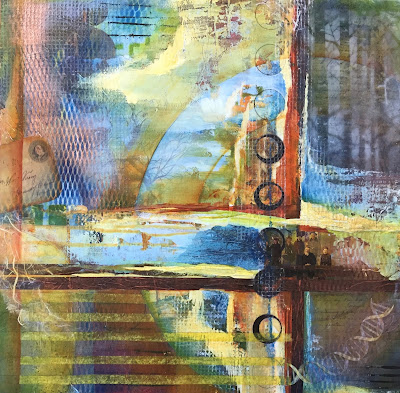
Collage has been my primary medium for 25 years. I’ve taught the history of collage with a PowerPoint of early collage artists including Kurt Schwitters. When I saw his 1920 painting, Ja Was, Bild?, at London's Tate Museum in 2012, I was moved to tears. The colors, the cardboard, the composition. I felt seen! A print of his painting has been in my studio ever since.
My large square “Schwittersation” is based on his even larger rectangular work. In the early stages of this painting, I was teaching a watercolor class, highlighting J.M.W. Turner and was influenced by his Light and Colour (Goethe's Theory): The Morning after the Deluge. So, my Schwitters got a glowing halo which helped tie the composition together. The large piece in the upper center is from Webster’s Encyclopedia of Dictionaries showing words that rhyme with “-ation” (thus, the title). My 91 year old mother contributed a grocery list, and there are pieces from a 2001 Metropolitan Art Museum Calendar with photos of the Unicorn Tapestries. I also used hand-painted tissue and Citri-solv papers (altered National Geographic pages), punched cardstock, mulberry papers, doilies, crackle medium, oil pastels and and graphite. Layers of history make collage exciting.
4/25/2023 11:30:05 PM

I will have a rather different style painting in an invitational art exhibition celebrating the 150th birthday of author Willa Cather. Her 100-year-old book, A Lost Lady, is the focus of this year’s Spring Conference at the National Willa Cather Center in Red Cloud, Nebraska. It’s a fabulous venue and excellent destination for literary tourism. The Foundation has tours of 8 buildings in this town where Cather lived for several years before attending college at the University of Nebraska.
In this book, Cather describes the Forrester place just outside “Sweet Water” as unremarkable. “The people who live there made it seem much larger and finer than it was.” When Niel Herbert is asked to drive Marian Forrester home after her visit to his uncle’s law office, she asks him to come in to the sitting room and warm up. Cather sets the stage: "It was a rather dark room, with walnut bookcases that had carved tops and glass doors. The floor was covered by a red carpet, and the walls were hung with large, old-fashioned engravings: The House of the Poet on the Last Day of Pompeii, Shakespeare Reading before Queen Elizabeth."
I had to stop reading to google these engravings and learned so much more! I found my image focusing on the House of the Tragic Poet, based on an 1832 illustration by William Gell, of the reconstructed house.
Why was the House of the Tragic Poet significant in A Lost Lady? It’s an actual home found in 1824 in the ruins of Pompeii, famous for its murals depicting Euripidean tragedies (notice collaged Images in my painting from three of the ancient home’s murals: Achilles surrendering Briseis to Agamemnon, Actor with a mask, and Helen Boarding a ship for Troy). Professor Matthew Hokom says the house’s murals are mostly about devotion and sacrifice of women and goddesses placed in agonizing situations, often due to helplessness of women in a society dominated by men.
"[The Cather library included] Lytton's 1834 novel, The Last Days of Pompeii....The novel views the rise of one culture and the death of its antecedent as inevitable but acknowledges that, with the end of pagan antiquity, something great is disappearing from the earth. This idea of a heroic age now vanished resonates throughout A Lost Lady with its eulogy for the sunset days of the pioneer....The reference to the Forresters' picture opens a window on Pompeii, which opens a window on the House of the Tragic Poet, which opens a window on the murals, which opens a window on the plays of Euripides, the entire series of perspectives deepening our understanding of Mrs. Forrester and the novel." (Hokom)
Cather expected her audience to be familiar with the city, given the cultural popularity of Pompeiian discoveries in the 19th century. Not only did Cather contemporaries Mark Twain and Henry James write of their visits to Pompeii, but in 1908 she was there. She wrote her friend, Alice Goudy, about two days spent at Pompeii and touring the Naples Museum, which includes artwork from the House of the Tragic Poet.
At Daniel’s funeral, Cather has Marian say, "I think I will have Mr. Forrester's sun-dial taken over and put above his grave. I can have an inscription cut on the base. It seems more appropriate for him than any stone we could buy. And I will plant some of his own rose-bushes beside it." Hokom notes: “In this passage the roses, representing Mrs. Forrester, and the stone, representing the Captain, are joined over his grave.” Earlier in the novel, Cather describes the sundial as being of red sandstone from Colorado. I took artistic license in the style of sundial in my painting.
With the sundial/gravestone and blush roses as the focal point in this painting, the picture from the Forrester’s house becomes the Forresters in the picture!
9/15/2021 3:06:48 PM

I participated in an invitational show last month at the Prairie Art Center in North Platte, Nebraska. Twenty-five artists answered the invitation and were randomly assigned one of 6 analogous color ranges with which to create. We could use shades and tints, with an open theme. I was assigned green to yellow. The resulting show was hung around the gallery walls in color wheel order and highlighted with large fresh flower arrangements in corresponding colors. Flowers were changed once a week to keep the exhibition fresh. It was a unique experience to be standing in the middle of the color wheel.
My painting, "Saint Analagous," is so titled because of the obvious analogous colors, but also because of words around the halo that say "very much like me" (an analogy) in 6 languages: Arabic, English, Spanish, Somali, German, French.
There was so much artistic struggle to finishing this painting. It was done on watercolor paper. I didn't use enough/the correct adhesive when applying it to the cradled board and the paper buckled terribly...even with lots of weight applied and extended drying time. The only way to fix this was to slice through the paper with a razor blade and force medium through the opening, using a brayer to flatten and spread the medium. More buckling happened from the fix! In the end, I used gridded rice paper to "bandage" the cuts and it actually makes the piece more interesting.
8/12/2019 1:30:04 PM

In December 2018, I discovered the wonders of literary tourism as I met my mother and sister in Red Cloud, Nebraska to research for a show with Impact Nebraska Artists inspired by writings and life of Willa Cather. The trip made me want to go to Key West and stay in Hemingway quarters, and to Missouri to see where Tom Sawyer was written, and to Concord, Massachusetts where Alcott wrote "Little Women." Toni Morrisons' hometown of Lorain, Ohio has several sites mentioned in her books. This trip opened a whole new reason for travel.
Red Cloud is a very small, but interesting town. I read at least five Cather novels before our visit, and it was like getting inside the author's mind to walk the streets she'd been on and sit in the train station from where she traveled to college, and back home from her work in New York. Red Cloud became "Black Hawk" in My Antonia, and Jim Burton, the narrative voice of the book rode to that train station with Willa. We saw the attic bedroom where she lived as a teenager, the church where she was a member and donated stained glass in honor of her parents, the bank and opera house she knew and used in her writings.
I could not have completed my Impact piece without the background readings, and tour of Red Cloud. My collage portrait places Willa in front of the Miner's house, next door to where she once lived, and part of the Willa Cather Foundation's tour in Red Cloud. The Miner family was her inspiration for the Harlings of My Antonia. This is where Antonia lived, and worked as a hired girl. Note that in my painting the shadows of siding on the house are actually collaged text from the book describing the Harling house. I was surprised to realize Cather provided no physical references to the house...only descriptions of the family. My portrait is referenced from a 1912 photo by Aime Dupont Studio in New York, in which the author wore a large cameo brooch. In this painting, I turned the cameo 45 degrees and changed the cameo image to the plow silhouetted in the setting sun as Cather describes in her book. This description is included in the shadows to the left of the image of Cather.
I highly recommend a visit to Red Cloud!
7/2/2018 10:28:59 PM
Last August we voted the new themed show of Impact Nebraska Artists to be "Nebraska Roots." We will gathered in March with 24 new artworks. The challenge of painting to a theme and showing with other amazing artists is intimidating. It stretches my imagination, skills, work processes, and understanding of self and others.

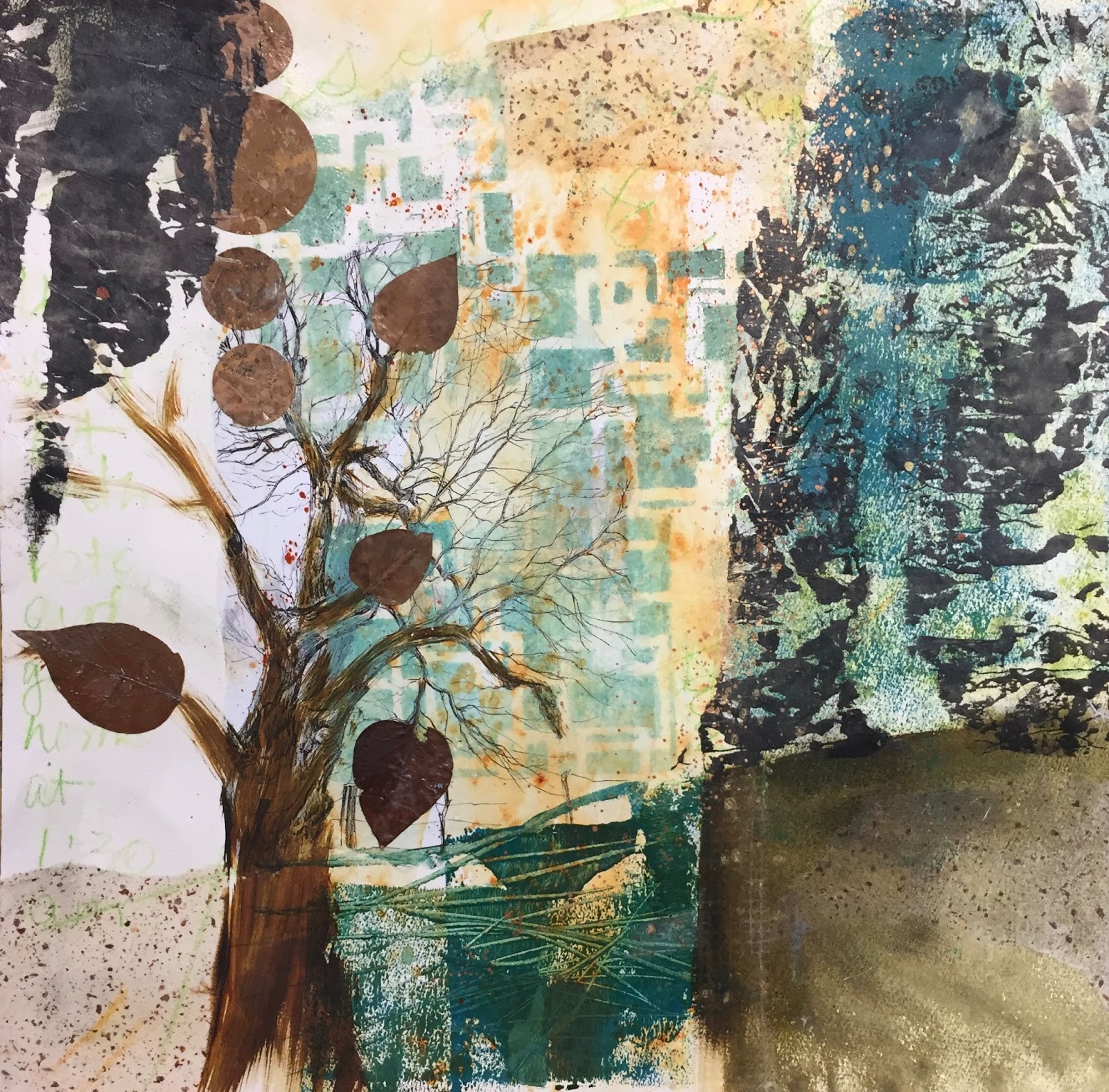
This painting has been a struggle. Started in September, it has been through many phases. Some of the middle stages were better than near the end! I consider my strength to be balanced compositions, though graphic lines and symbols are often used as a crutch to create balance and focal points.
Years ago, I created a collage around a photo of
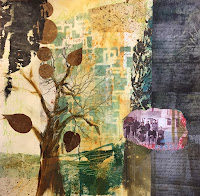 my great-grandparents and their four children (the hired man was also in the photo). I had several prints of this small painting and used it in an early stage of Nebraska Roots. The image became precious...thus, the struggle. It's difficult to work around a part that you love in a collage, because it may become obliterated...or try to take over the composition. You can see here the photo fights the tree as a focal point. And I loved the real pressed leaves on that tree! They had to go.
 My brother had done a lot of family history work a few years ago, and mom had given him a box of family documents. He emailed me some photos of letters our great-grandfather, William Vasey, had written in 1879 to"Eliza, my dear wife," who stayed in Iowa while he set up the homestead in Dawson County, Nebraska. I made gel transfers of his beautiful handwriting (on the right), creating another "precious" problem.
 In the letters, he answers her questions about Indians in the region (1500 camped in the western part of Frontier County), tells of being cheated out of one site, going over 50 miles to the Loup River to obtain cedar logs for foundation of their house, and says land is going fast.. "if there is anyone wanting to come out here, tell them they had better come soon."
On the left, to balance the script on the right, I collaged a copy of an envelope addressed to Mrs. Wm. Vasey, Grundy County, Iowa.
 Here, in the fifth photo, I tried to lose the precious, but couldn't because that's what it was all about! I had actually painted over my grandfather, and could hardly see the great-grandparents...so I cut out duplicate images of those three, making them more important (though still pretty small), and actually moved my grandfather to the place where the hired man was in the original.
 My son had a surprising critique for me. He said I'm too subtle! He saw color and missed all the hidden detail until I pointed it out. And he That's sort of how I've always painted...using the layers of collage to hide secrets.
I want to try another version of this theme and format. If it turns out better, I may swap out this Impact piece. Check impactart-ne.org to view other artists' versions of Nebraska Roots, as well as our four other exhibits. "Skyscape" will be in Bancroft, Ne during April.